

Overview
Almost everyone tries to manage hair fall at home first. Oils, supplements, diet changes, special shampoos, the particular brand someone swore by in a YouTube comment. Some of it helps a little. Some of it does nothing. And at some point, the hair fall continues long enough or intensely enough that the home approach clearly is not addressing whatever is actually driving it.
The frustrating part is that most people do not know where that line is. How much hair fall is normal? How long should you try home management before seeing someone? Is the shedding getting better or worse or just staying the same? These questions stay unanswered for months while the window for the most effective intervention gradually narrows.
At Mediluxe in Janakpuri, Dr Simran Saxena treats hair fall as the medical concern it is rather than a cosmetic afterthought. The approach starts with identifying the cause, which is the part most home treatments never address, and building a plan around what is actually driving the loss.
What Counts as Normal Hair Fall and What Does Not
On average, losing between 50 and 100 hairs per day is considered normal. Hair grows in cycles, and shedding is part of that cycle. The problem is not that hair falls out. It is when more hairs are lost than are being replaced, or when the replacement hairs are finer and shorter than the ones that were lost.
Signs that hair fall has moved beyond the normal range:
• Noticeably more hair on your pillow, in the shower, or on your hairbrush than usual
• The parting has become visibly wider over several months
• The hairline has receded at the temples or forehead
• Hair feels thinner or lighter overall, even though the length has not changed
• Scalp is more visible in certain lighting than it used to be
Any of these persisting for more than two to three months without an obvious trigger is worth investigating properly rather than managing with products.
Why the Cause Matters More Than the Treatment
Hair fall treatment is often planned alongside other aesthetic services at Mediluxe when a patient is addressing more than one concern at a time.
Hair fall has many different causes, and the treatment for each one is different enough that using the wrong approach not only fails to help but can sometimes make things worse.
Androgenetic alopecia is a genetic pattern of hair loss driven by DHT, a derivative of testosterone, which progressively miniaturises hair follicles over time. It affects both men and women, follows a characteristic pattern, and does not stop on its own without intervention. Oils and supplements do not reverse follicle miniaturisation.
Telogen effluvium is a temporary shedding response triggered by physical or emotional stress, illness, nutritional deficiency, hormonal changes, or a significant life event. It typically begins 2 to 3 months after the triggering event and can look alarming in its intensity. The follicles are not permanently damaged, and hair regrows once the trigger is resolved, but the process can take 6 to 12 months.
Iron deficiency and anaemia are among the most common and most frequently missed causes of hair fall in women in India. Ferritin levels below a certain threshold impair the hair growth cycle even when haemoglobin appears normal on a basic blood test. This is why proper blood testing is essential before any hair fall treatment plan is recommended.
Thyroid dysfunction affects hair growth cycle timing at a cellular level. Both hypothyroidism and hyperthyroidism can cause significant shedding that does not respond to topical or clinical hair treatments until the underlying thyroid issue is addressed.
Scalp conditions, including seborrheic dermatitis, scalp psoriasis, and fungal infections, create an inflamed scalp environment that disrupts hair growth. Treating the scalp condition is what resolves this type of hair fall, not PRP or mesotherapy.
What Blood Tests Should Actually Be Done
This is one of the most commonly skipped steps in hair fall management and one of the most important. Before any treatment recommendation at Mediluxe, Dr Simran reviews a baseline set of investigations that typically includes:
• Complete blood count
• Serum ferritin and iron studies
• Thyroid function tests including TSH, T3, and T4
• Vitamin D and B12 levels
• Hormonal panel including DHEAS and testosterone for women with pattern-type loss or facial hair concerns
Treating hair fall without this information is guesswork. Treating it with this information allows the plan to address the actual cause rather than just the visible symptom.
What Clinical Treatments Are Available at Mediluxe
Once the cause is established, treatment is built around what will actually address it.
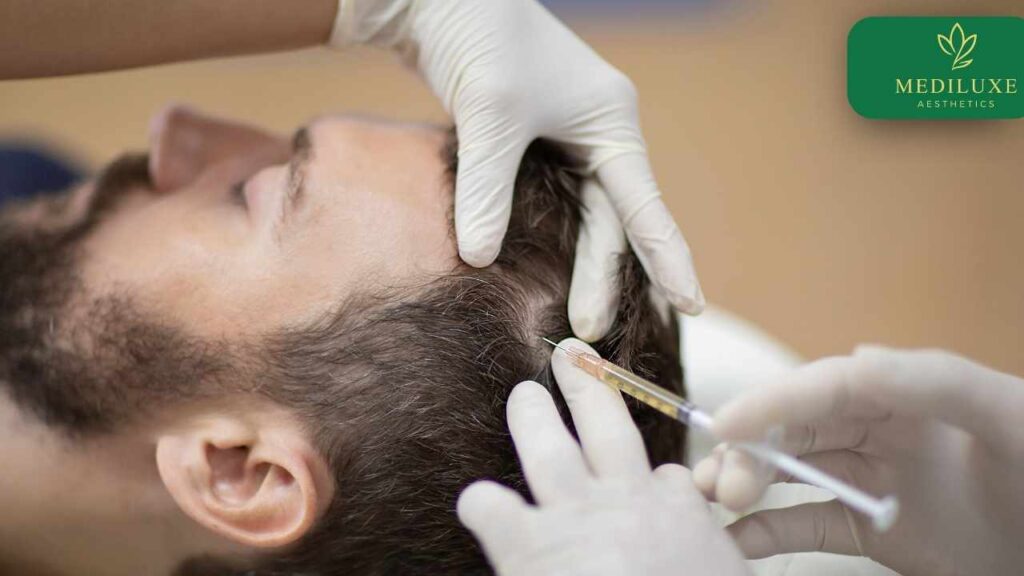
PRP and GFC therapy are two of the most effective clinical options for androgenetic alopecia and post-effluvium recovery, where follicles are still present but underperforming. Both use growth factors derived from the patient’s blood to stimulate dormant follicles and improve the scalp environment. GFC delivers a higher concentration of growth factors than standard PRP and typically produces more consistent results over a shorter treatment course.
Mesotherapy delivers a customised blend of vitamins, minerals, and growth factors directly into the scalp via microinjections. It nourishes follicles at a depth that topical products cannot reach and is often used alongside PRP or GFC for a more comprehensive approach.
Topical prescription treatments, including minoxidil, are incorporated into the plan where appropriate. The evidence for minoxidil in both male and female pattern loss is well established, and Dr Simran recommends the concentration and application method suited to each patient’s specific pattern and scalp sensitivity.
Nutritional correction when deficiencies are identified is treated as part of the clinical plan, not an add-on. Supplementing iron, vitamin D, or B12 where genuinely deficient is sometimes the primary intervention needed before any procedural treatment begins.
You can see the full range of aesthetic services at Mediluxe to understand how hair treatments are offered alongside other skin and wellness concerns at the clinic.
When Home Remedies Have Clearly Stopped Being Enough
The answer to the question in the title is: when the shedding has been going on for more than two to three months without a clear resolving trend, when the parting or hairline is visibly changing, when products and oils have made no noticeable difference after consistent use, or when the hair fall is affecting confidence on a daily basis.
Any one of those is reason enough to have a proper assessment rather than continue managing something that may need a clinical intervention to resolve.
Conclusion
Hair fall is not always a simple problem with a simple solution. It has multiple possible causes that need to be identified before any treatment makes sense. The home management phase is reasonable for a short time. When it stops producing results and the shedding continues, a proper clinical assessment that includes blood tests and scalp evaluation is genuinely the most useful next step rather than trying another product.
FAQ SECTION (SEO + SCHEMA READY)
Frequently Asked Questions
Q. How do I know if my hair fall is permanent or temporary in Janakpuri?
A proper assessment, including blood tests and scalp examination at Mediluxe, is the only reliable way to determine this. Pattern loss with follicle miniaturisation is progressive without treatment. Telogen effluvium and deficiency-related shedding are generally reversible once the cause is addressed.
Q. How many PRP or GFC sessions are needed for hair fall in Janakpuri?
Most courses involve 4 to 6 sessions spaced 2 to 4 weeks apart, followed by maintenance sessions every 3 to 6 months. Dr Simran recommends the specific number based on the degree of hair loss and how the scalp responds to initial sessions.
Q. Can hair fall treatments at Mediluxe be combined with dental treatment?
Yes. Mediluxe is a combined aesthetic and dental clinic. Patients managing hair fall treatment and dental concerns can address both at the same clinic rather than attending separate facilities.
Q. What is the difference between PRP and GFC for hair fall?
PRP uses platelet-rich plasma from the patient’s blood. GFC uses a more refined growth factor concentrate that delivers a higher concentration of the specific growth factors driving follicle stimulation. GFC typically produces more consistent results and is increasingly preferred at Mediluxe for most hair fall cases.
CTA