
Overview
There is a particular kind of decision paralysis that happens around skin laxity. People notice it. They mean to do something. They look into it occasionally. And then months pass, sometimes years, and the looseness that was mild and manageable becomes more established and harder to address without more intensive intervention.
This is not a scare tactic. It is just biology. Collagen and elastin do not regenerate on their own once production slows. They respond to stimulation, which is exactly what clinical skin tightening treatments provide. The earlier that stimulation happens, the less work it has to do and the more complete the result tends to be.
At Mediluxe in Janakpuri, Dr Simran Saxena approaches skin tightening with a focus on what the individual patient’s skin actually needs rather than defaulting to the most premium-sounding option. The conversation starts with understanding what is causing the laxity and what stage it is at before anything is recommended.
What Is Actually Happening Beneath the Skin as It Loosens
Skin firmness comes from two proteins: collagen and elastin. Collagen provides structural support, the scaffolding the skin sits on. Elastin allows the skin to spring back after movement or compression. Together they determine how firm, bouncy, and defined the skin looks and feels.
From the mid-30s onward, the body produces less of both. Not dramatically, not all at once, but consistently and cumulatively. On top of this, Delhi’s pollution and UV exposure accelerate the oxidative stress that degrades existing collagen faster than it would in a less harsh environment.
The visible result is progressive. The jaw softens. Skin around the cheeks feels heavier. Fine lines around the eyes and mouth become more settled. The skin has the same surface but less structure beneath it. That is skin laxity, and it does not reverse with topical products alone because collagen is not made at the skin’s surface.
Why Waiting Makes Skin Tightening More Difficult
Mild laxity responds well to non-invasive treatments. The collagen production that these treatments stimulate is enough to make a visible and lasting difference when the starting point is relatively early.
Moderate to significant laxity has already experienced more structural loss. More sessions are needed. The results, while real, require more time to build. And in cases where laxity has progressed substantially, the honest conversation shifts to whether non-surgical options can achieve the patient’s goals or whether a different approach is more appropriate.
This is the practical argument for acting earlier rather than later. Not vanity. Not urgency driven by marketing. Just the biology of how much stimulation is needed to produce a meaningful result at different stages of laxity.
What Skin Tightening Treatments Are Available at Mediluxe?
Dr Simran uses a combination approach depending on what the skin actually needs, the degree of laxity, the area of concern, and the patient’s timeline and preferences.
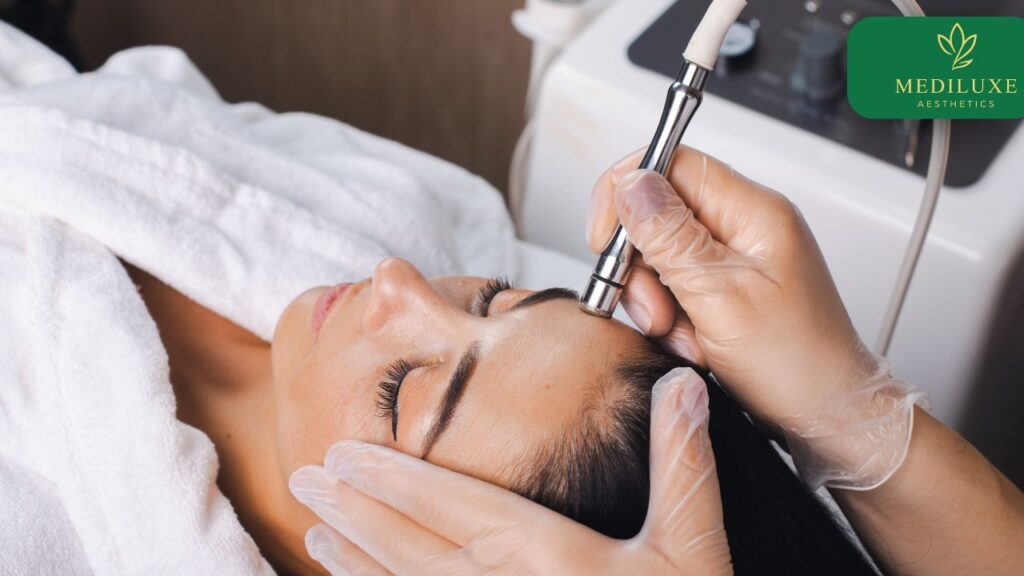
Radiofrequency treatment delivers controlled heat energy into the deeper layers of skin. The heat stimulates collagen production from within the dermis rather than at the surface. Results build gradually over 4 to 8 weeks as new collagen develops and continue improving for months after the treatment course. It is safe across all Indian skin tones and produces no visible downtime. Effective for the face, jaw, neck, and body areas.
Mesotherapy and skin boosters deliver hyaluronic acid, vitamins, peptides, and other active ingredients directly into the skin via microinjections. These support skin hydration at a depth that topical products cannot reach and create the kind of plump, supported skin texture that looks significantly more youthful than dehydrated skin, regardless of laxity. Often used alongside RF as part of a combined plan.
Thread lifts provide a more immediate mechanical lifting effect by placing fine dissolvable threads just beneath the skin surface. They produce visible results from the first session and continue stimulating collagen as they dissolve over months. Suited to patients with early to moderate sagging around the cheeks and jawline who want a more immediate visible change alongside longer-term collagen building.
Chemical peels support skin quality and surface tightening by accelerating cell turnover and stimulating collagen at a shallower depth. Used as a supporting treatment alongside RF or threads rather than as a primary tightening option. The chemical peels available at Mediluxe are selected based on the patient’s skin type and the specific concern being addressed.
How Dr Simran Decides What to Recommend
The consultation at Mediluxe is not a menu selection exercise. Dr Simran examines the skin, assesses the degree and location of laxity, and asks about lifestyle, sun exposure, and the patient’s goals and timeline. The recommendation that comes from that conversation is specific to what is actually going on rather than a standard package applied to every patient.
Some patients need RF alone. Some need a combination of RF and skin boosters over several months. Some need threads alongside other treatments for a more immediate and sustained result. And some patients who come in asking about skin tightening leave the consultation with a different primary recommendation because what they thought was laxity is actually volume loss or dehydration, both of which respond better to different treatments.
That kind of honest assessment is what makes the outcome worth the investment.
What to Expect From a Course of Skin Tightening Treatment
Many patients combine skin tightening with other aesthetic services at Mediluxe to address multiple concerns during the same treatment plan.
Results from skin tightening at Mediluxe are gradual rather than immediate, with the exception of thread lifts, which produce visible change on the day. For RF-based treatments, the improvement builds over 4 to 8 weeks after each session and continues for months as collagen remodelling progresses.
A typical course involves 3 to 6 sessions spaced 2 to 4 weeks apart, depending on the treatment and the degree of laxity. Maintenance sessions every few months after the initial course sustain the results by continuing to stimulate collagen production before the previous round of new collagen begins to break down naturally.
Sun protection is essential throughout and after treatment. UV exposure is one of the primary drivers of collagen degradation. Treating laxity while continuing to expose the skin to unprotected UV is working against yourself. Daily SPF in Delhi’s sun is part of the treatment plan, not an optional afterthought.
You can explore the full range of aesthetic services at Mediluxe to understand what else might be relevant alongside skin tightening as part of a broader skin health plan.
Conclusion
Skin laxity does not improve on its own, and it does not stay the same. The progressive nature of collagen loss means mild laxity addressed now is a simpler, more effective conversation than moderate laxity addressed later. Non-surgical skin tightening in Janakpuri works when it is matched correctly to what the skin actually needs, started at the right stage, and maintained consistently enough to keep the results building over time.
Frequently Asked Questions
Q. How many skin-tightening sessions are needed at Mediluxe in Janakpuri?
Most patients need 3 to 6 sessions for an initial course, depending on the degree of laxity and the treatment being used. Dr Simran discusses the specific recommendation after examining the skin at the first consultation.
Q. Is skin tightening treatment painful?
Radiofrequency treatment is described by most patients as warm pressure rather than pain. Thread lifts involve local anaesthetic, so discomfort during the procedure is minimal. Most treatments at Mediluxe have no significant downtime.
Q. At what age should I start thinking about skin tightening in Janakpuri?
There is no fixed age. The right time is when you notice a change that genuinely bothers you and want to address it before it progresses further. For most people, this is somewhere in the mid-30s to early 40s, but varies significantly based on genetics, sun exposure, and lifestyle.
Q. Can skin tightening treatment be combined with other aesthetic treatments?
Yes. Dr Simran often combines skin tightening with skin boosters, chemical peels, or other treatments depending on what the patient’s skin needs. The combination is planned to complement rather than conflict.
CTA