
Overview
Acne scars are one of the more frustrating skin concerns to deal with because the timeline for seeing results is long, and the range of treatments that claim to work is enormous. People spend months on serums, months on one type of treatment, switch to another, and still feel like they are not getting anywhere.
The reason acne scars take so long is not that they are particularly resistant to treatment. It is because they represent actual structural changes in the skin — changes in collagen architecture, changes in melanin distribution, changes in skin surface texture — and those changes need specific interventions matched to what is actually present.
At Mediluxe in Janakpuri, Dr. Simran Saxena treats acne and acne scarring as two separate concerns that often need different approaches running in parallel. Active acne is managed differently from the marks and structural damage it leaves behind.
Why Does Acne Leave Scars at All?
When acne becomes inflamed, it damages the dermis, the deeper layer of skin where collagen and elastin provide structure. The body repairs that damage by producing collagen, but the repair is rarely perfect. Too little collagen produces a depressed scar. Too much produces a raised one. And the inflammation itself often triggers melanin overproduction, which leaves flat dark marks even when the structural damage is minimal.
None of this is caused by picking or squeezing alone. Severe inflammatory acne scars, regardless of whether they are touched. Picking makes it worse and more likely to scar, but plenty of people who never touched their acne still end up with significant scarring.
What Type of Scar Determines What Treatment Works?
This is the single most important thing to understand before spending money on any acne scar treatment.
Post-inflammatory hyperpigmentation is flat dark marks left after inflammation. Not a true scar, but often grouped with scarring because of how it looks. Responds well to chemical peels, certain laser treatments, and skin brightening protocols over 2 to 3 months.
Rolling scars create a wave-like uneven texture across the skin surface. Caused by fibrous bands beneath the skin pulling the surface downward. Need treatments that address the tethering — subcision, microneedling, or laser resurfacing.
Boxcar scars are wider depressions with defined edges. Respond well to fractional laser resurfacing and deeper chemical peels over multiple sessions.
Ice pick scars are narrow and deep. The most difficult type to treat is because of how far into the skin they go. Need specialized approaches and more sessions than other scar types.
Hypertrophic and keloid scars are raised. More common on the chest, back, and jaw. Need a completely different approach from depressed scars, including steroid injections and specific laser protocols.
A treatment plan that does not account for scar type is guessing. At Mediluxe, Dr Simran identifies what types of scarring are present before recommending anything.
What Treatments Actually Work for Acne Scars in Janakpuri?
Microneedling creates controlled micro-injuries in the skin that trigger collagen production. Particularly effective for rolling and boxcar scars over multiple sessions. At Mediluxe, it is often combined with PRP or GFC to boost the collagen response and speed up results.
Chemical peels at clinical depth address surface texture, post-inflammatory pigmentation, and shallow scarring. The peel type and depth are matched to the scar concern and skin tone. You can explore the full range of skin treatments at Mediluxe to understand what peel options are available.
Laser treatments reach deeper layers than peels or microneedling and are more effective for moderate to severe structural scarring. At Mediluxe, laser treatments are calibrated for Indian skin tones specifically, which matters because incorrect settings can cause post-inflammatory pigmentation in darker skin. The same laser expertise used for laser hair reduction at Mediluxe carries through to scar treatment.
Skin brightening treatments for post-inflammatory pigmentation include targeted topical protocols, chemical peels, and laser toning. These work faster than structural scar treatments because they are addressing melanin distribution rather than collagen architecture.
Combination approaches almost always produce better results than any single treatment. A plan that combines microneedling sessions with chemical peels and a targeted skincare protocol addresses multiple aspects of the scar simultaneously rather than working on one thing at a time.
Why Does It Take So Long?
Collagen production is slow. The body produces new collagen in response to treatment, but the remodelling process takes 4 to 6 weeks per session to build. Multiple sessions spaced apart allow each round of collagen production to contribute to the cumulative improvement before the next session adds to it.
Post-inflammatory pigmentation fades faster than structural scarring, usually over 2 to 4 months with appropriate treatment. Structural scars take longer, typically 4 to 6 months of consistent treatment, to see meaningful improvement.
This is why abandoning treatment after 2 sessions and deciding it is not working is one of the most common reasons people feel like nothing helps. The results are there, but they arrive on the skin’s timeline, not an immediate one.
How Does Active Acne Affect Scar Treatment?
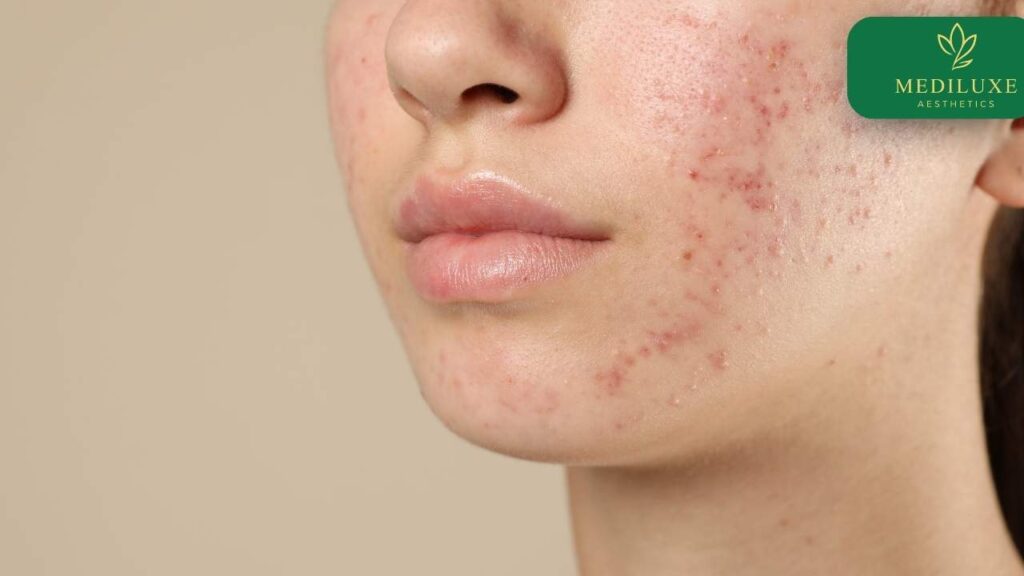
Active acne needs to be under control before scar treatment begins properly. Treating scars while new inflammatory acne keeps creating new damage is like repainting a wall that keeps getting marked. The scar treatments cannot keep up.
At Mediluxe, active acne management and scar treatment are sequenced. Active acne is brought under control first through appropriate clinical treatment, and then scar work begins. In practice, the two phases often overlap because the transition from active to controlled acne is gradual.
Conclusion
Acne scars take time because they represent real biological changes in the skin. The treatments that work are the ones matched to the specific scar type and run for long enough to allow the skin’s repair processes to build up. Impatience and switching treatments before seeing the full result of a proper course are the thing that most often gets in the way of real improvement.
Book an Acne Scar Consultation at Mediluxe, Janakpuri
Frequently Asked Questions
Q. How many sessions does acne scar treatment take at Mediluxe in Janakpuri?
Most patients need between 4 and 6 sessions of microneedling or laser treatment spaced 4 to 6 weeks apart for meaningful improvement. Severe scarring may require more. Post-inflammatory pigmentation responds faster than structural scarring.
Q. Can acne scar treatment be done while still having active acne?
Active acne is ideally brought under control before intensive scar treatment begins. Dr. Simran sequences treatment appropriately and, in many cases, addresses both concurrently in a coordinated plan.
Q. Is acne scar treatment safe for Indian skin tones in Janakpuri?
Yes, when performed by a practitioner experienced with Indian skin. At Mediluxe, Dr. Simran calibrates all laser and peel treatments for Indian skin tones to avoid triggering post-inflammatory pigmentation as a side effect of treatment.
Q. What is the difference between post-inflammatory hyperpigmentation and an actual acne scar?
Post-inflammatory hyperpigmentation is flat dark discoloration caused by melanin. It is not a structural scar and fades faster with appropriate treatment. Acne scars involve changes in skin texture and collagen structure that require more targeted clinical intervention.
